




LED Bar Lights Specs: Lumens, IP Rating and Color Temp Explained
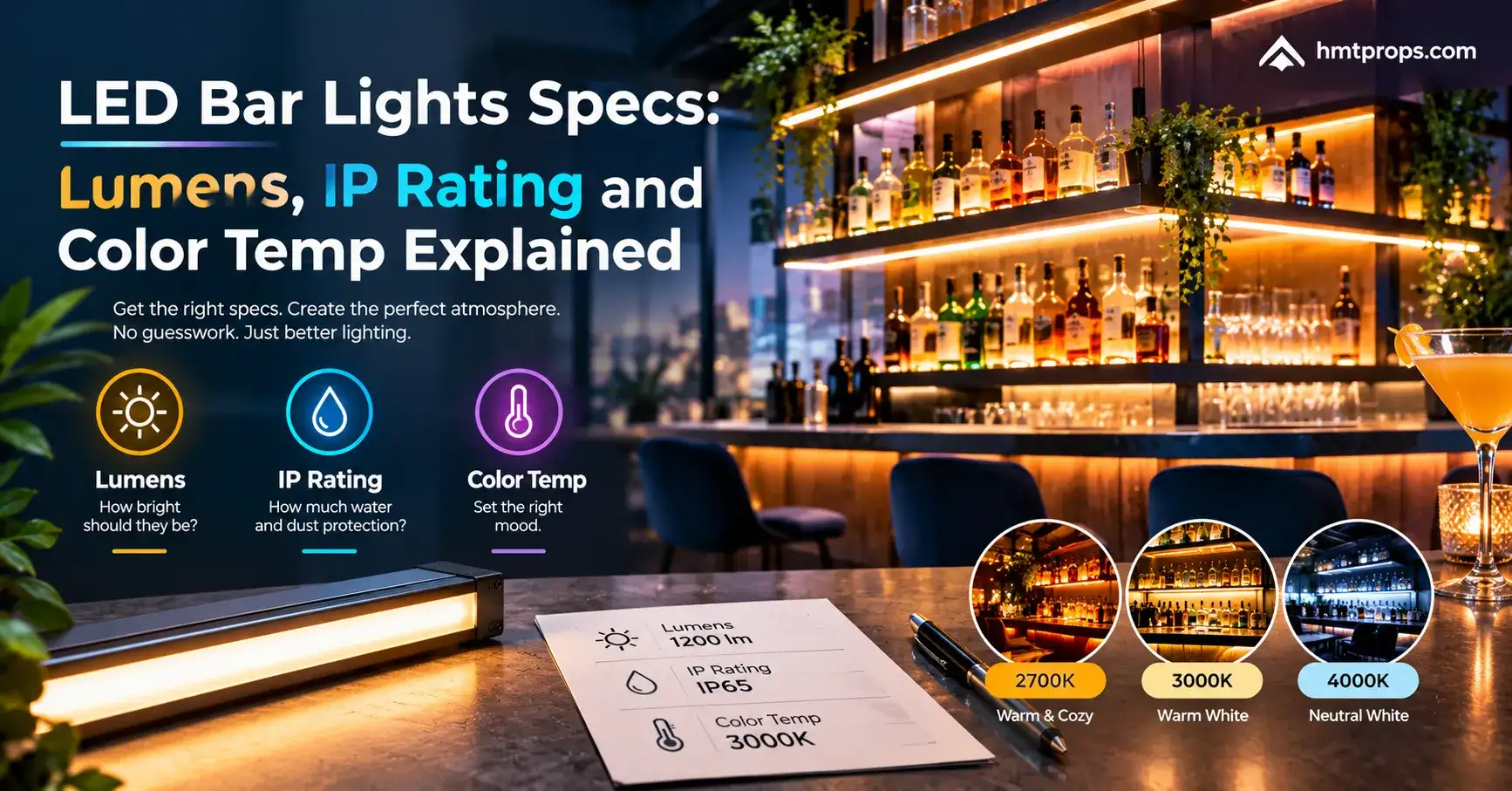
A supplier sends you a spec sheet: 1,200 lm, IP65, 3000K. Looks fine. Then the shipment lands. The back bar looks flat, two batches don't match, and the units by the glass washer fog up inside. Ouch.
Most of those problems trace back to three numbers. This guide breaks down LED bar lights specs in plain English, so you know which values fit each part of a bar or display before you place a bulk order.
Quick answer: For most indoor bars, pick commercial LED bar lights with lab-measured lumens, IP65 or IP66 anywhere water gets sprayed, and 2700K to 3000K warm white with a CRI of 90 or higher. For lights in a row, ask for 3-step LED binning so every unit matches.
LED Bar Lights vs LED Light Bars: Know Which One You're Buying
Search "LED light bar," and you'll mostly find off-road gear for trucks. Those lights throw a beam far down a dark trail. This guide covers slim LED bar lights for bars, clubs, restaurants, bottle display shelves, and retail fixtures. (For the wider product family, see these types of bar lights for B2B sourcing.)
Same units, very different values. A light that's perfect on a roof rack would blind your guests at the counter.
Lumens: How Bright Should LED Bar Lights Be?
Lumens (lm) measure the total visible light a fixture gives off. More lumens, more light. But a spec sheet can still fool you.
Lumens, Lux and Watts Aren't the Same Thing
- Lumens: light leaving the fixture.
- Lux: light landing on a surface. One lux is one lumen spread over one square meter.
- Watts: power drawn. Not brightness.
The bridge between them is luminous efficacy, or lumens per watt (lm/W). Higher means more light for every watt, which adds up fast when hundreds of units run every night.
For linear fixtures, compare lumens per meter too. Bar lights come in different lengths, so lumens per unit can make a short, bright light look weaker than a long, dim one.
Ask for Measured Lumens, Not Chip Lumens
Some listings just add up the rated output of every LED chip. That's a best-case number. Real fixtures lose light through the diffuser, the housing, and heat.
The fair figure comes from an LM-79 test, which measures the complete fixture: light output, power draw, efficacy, color temperature, and CRI. If a supplier only quotes chip lumens, treat it as a ceiling, not a promise.
A Quick Brightness Check You Can Do on Paper
Say a 1-meter shelf light gives 400 lumens and lights a shelf face 1 meter wide and 0.4 meters tall. If every lumen landed there, you'd get 400 ÷ 0.4 = 1,000 lux. Real readings come in lower, since the beam angle sends some light past the shelf. But the same math on two quotes shows which one puts more light where you need it.
On back bar shelves, you're after contrast. Bottles should glow brighter than the room, not look like they're under a hospital lamp.
IP Rating: How Much Water and Dust Protection Do You Need?
Bars are wet. Ice melts, glasses get rinsed, spills get wiped. The LED bar light IP rating tells you how well a fixture keeps all that out.
How to Read the Two Digits
IP stands for ingress protection, defined in the international standard IEC 60529. The first digit (0 to 6) covers solids like dust. The second (0 to 9) covers water. An X means that part has no rating, not zero protection.
So what IP rating for bar lighting makes sense? Match it to the spot:
|
Rating |
What it means |
Where it fits |
|
IP20 |
Blocks fingers. No water protection. |
Dry, enclosed display cases |
|
IP44 |
Blocks objects over 1 mm. Handles splashes. |
Shelves that catch the odd splash |
|
IP65 |
Dust-tight. Handles low-pressure water jets. |
Under counters, near sinks and glass washers |
|
IP66 |
Dust-tight. Handles powerful water jets. |
Zones hosed down during cleaning |
|
IP67 |
Dust-tight. Survives temporary immersion (1 m for 30 minutes). |
Spots where water pools |
|
IP68 |
Dust-tight. Survives longer immersion, as the maker specifies. |
Water features and ice displays |
IP65 vs IP67: The Mix-Up That Catches Buyers
It's easy to assume IP67 beats IP65 at everything. It doesn't. For IP65 vs IP67, think "spray" vs "dunk."
An IP65 light gets hit with water from a 6.3 mm nozzle. An IP67 light sits about 1 meter underwater for 30 minutes. Passing the dunk doesn't prove it can take the spray. If you need both, the spec should say IP65/IP67.
So ask how water will reach the light. Sprays and wipe-downs? IP65 or IP66. Pooling? IP67 or IP68. And keep pressure washers away from all of them.
Color Temperature: Picking the Right Kelvin for the Mood
Correlated color temperature (CCT) describes how warm or cool white light looks. It's measured in Kelvin (K). ENERGY STAR sorts white light into three groups:
- 2200K to 3000K: warm and yellowish, like old incandescent bulbs
- 3500K to 4100K: whiter, neutral light
- 5000K to 6500K: cool and bluish
Any LED bar light color temperature on a quote sits somewhere on that scale.
Warm White vs Cool White in a Bar
So what's the best color temperature for bar lighting? For most lounges, restaurants, and back bars, warm white around 2700K to 3000K. The U.S. Department of Energy notes that warm light flatters skin tones. Your guests look better, and the room feels softer. Put a bottle of whiskey under 2700K, then under 6000K, and ask which one you'd rather order.
Warm white vs cool white isn't a contest. Cooler light (4000K and up) boosts contrast, which suits prep areas and retail displays. Nightclubs may skip white light entirely and use colored bottle bar lights.
Don't Skip CRI and R9
Two lights can both say 3000K and still look different. The color rendering index (CRI) scores how true colors look on a 0 to 100 scale. Some makers also list R9, which measures how well a light shows strong reds.
The DOE says color rendering generally matters more than color temperature. For CRI for commercial lighting, 90 or higher is a sensible target when you're showing red labels, wine or food. A weak R9 can make a bright red logo look flat and muddy.
Make Sure Every Unit Matches
This one's easy to miss, and it hurts most on a big order. No two LEDs come off the line exactly the same color. Makers sort them through binning, measured in MacAdam ellipse steps, also called SDCM.
A 1-step difference is invisible. Standard ANSI bins are roughly a 7-step ellipse, which can look patchy when lights sit in a row. So ask for 3-step binning, and on reorders, ask the supplier to match your original bin. Nothing spoils a polished back bar like one new light that's a little greener than the rest.
Two More Specs That Protect Your Order
12V vs 24V
In the 12V vs 24V choice, 24V usually wins on long runs. It draws half the current for the same power, so there's less voltage drop. Fed from one end, a typical 12V LED strip stays even for about 5 meters, and a 24V strip for about 10. Past that, the far end dims and can shift color.
Lifespan Claims: Look for L70
A "50,000 hours" sticker means little without proof. LM-80 tests how LED chips hold brightness over at least 6,000 hours. TM-21 projects that data forward to estimate L70, when output drops to 70% of the original. These tests cover the LEDs, not the driver or seals, so they don't promise the whole fixture lasts that long.
LED Bar Light Spec Sheet Checklist for Bulk Buyers
Before you approve an order of wholesale LED bar lights, send your supplier this LED bar light spec sheet checklist:
- Lumens per unit and per meter, from an LM-79 report
- Full IP rating and the water tests passed
- Color temperature in Kelvin, with tolerance
- CRI and R9 values
- Binning tolerance in SDCM
- Input voltage and maximum run length
- LM-80 and TM-21 data behind lifespan claims
- Dimming method and driver compatibility
- Housing and diffuser material
- A pre-production sample from your order's LED batch
Clear LED bar light specifications answer every line. If a supplier can't, ask why before you sign.
Get the Specs Right Before You Order
Good LED bar lights specs come down to three numbers working as a team. A bright light in the wrong Kelvin feels harsh. A lovely warm light with the wrong IP rating won't survive a busy weekend. Match each spec to where the light will live, ask for test-backed numbers, and you'll dodge most costly surprises.
Sourcing for bars, restaurants, or bottle shelves? Hongmiao Technology's LED bar lights cover those settings, with custom size, brightness, and color options for wholesale orders. Send your checklist and request a quote that answers every line.
FAQs
How many lumens do LED bar lights need?
There's no single number. It depends on mounting distance, beam angle, and how bright the room is. Compare lumens per meter across quotes, then divide lumens by the lit area in square meters to estimate lux. For accent lighting, the shelf should look clearly brighter than the room.
What IP rating is best for bar lighting?
IP20 works for dry, enclosed display cases. Use IP44 where splashes happen, and IP65 or IP66 near sinks, glass washers, or anywhere staff spray during cleaning. Choose IP67 or IP68 only where water can pool on or cover the light.
Is IP67 better than IP65?
Not always. IP65 is tested against water jets. IP67 is tested by holding the light about 1 meter underwater for 30 minutes. Passing one test doesn't mean passing the other, so ask for IP65/IP67 if you need both.
What color temperature is best for a bar?
Warm white, around 2700K to 3000K, suits most lounges, restaurants, and back bars. It flatters skin tones and feels relaxed. Cooler light, 4000K and up, gives more contrast for prep areas and retail displays.
What CRI should commercial LED bar lights have?
Aim for CRI 90 or higher wherever color matters, such as branded bottles, wine, and food. Also check the R9 value, which shows how well the light renders strong reds like logos and labels.
Are LED bar lights the same as LED light bars?
No. "LED light bar" usually means a high-output vehicle light for off-road driving. LED bar lights for venues are slim, lower-output fixtures made for shelves, counters, and displays.
Featured Articles
A supplier sends you a spec sheet: 1,200 lm, IP65, 3000K. Looks fine. Then the shipment lands. The back bar looks fla...
READ FULLTwo suppliers quote you the same design, the same 200 signs. One lands at $11,000. The other at $18,500. Both call th...
READ FULLWholesale is no longer a promise; it's a price tag. Put it into any B2B marketplace, and you'll receive a deluge of l...
READ FULL