




What Makes a Neon Sign Truly Wholesale-Grade?
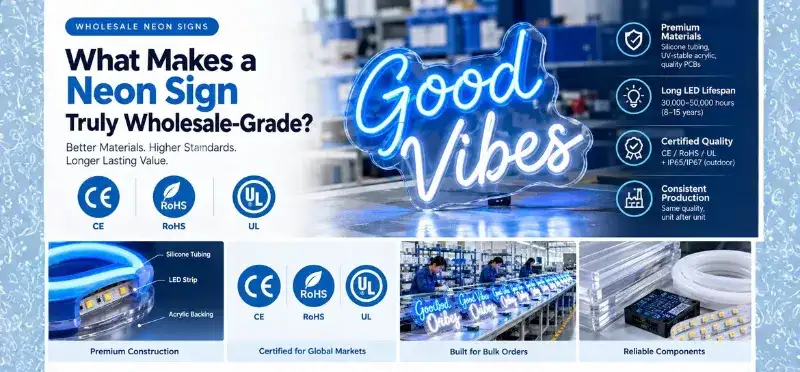
Wholesale is no longer a promise; it's a price tag. Put it into any B2B marketplace, and you'll receive a deluge of listings that say they are wholesale, but really mean "cheap" or "bought in bulk from the lowest bidder. That's not what wholesale grade means, and that's where retailers and distributors get burned.
A true wholesale-grade neon sign is not determined by the quantity ordered. It's about whether the materials, construction, and quality control used in that sign can withstand shipping, years of daily wear and tear, and resale to your customers without increasing returns or complaints. Low-grade signs and wholesale-grade signs can be priced at the same level, and six months later, one is still evenly glowing while the other is flickering, yellowing, or dead.
This article explains the actual technical specifications, materials, LED life, certifications, and production consistency that distinguish real wholesale-grade neon signage from a marketing label attached to a discount product.
The Materials That Separate Wholesale-Grade From Cheap Imitations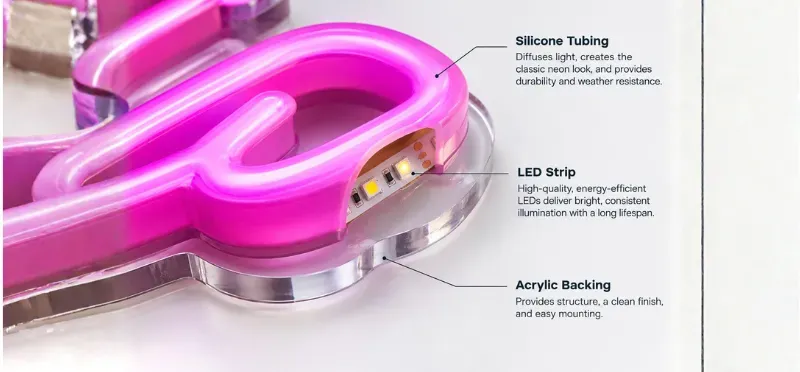
The quality of the materials is the key to wholesale-grade construction, beginning with the tubing. The silicone neon flex tubing is used in wholesale-grade units instead of traditional glass for two practical reasons: silicone does not crack under vibration and pressure during freight shipping, and it retains its color and flexibility much longer with continuous use.
Thin, low-quality PVC or unshielded flex tubing is often used in cheap imitations and may look similar in a product photo, but it breaks down, discolors, or becomes brittle within months, particularly in warmer climates or in direct sunlight.
The backing and internal wiring are important too:
- The acrylic backing material should be UV-stabilized and firm rather than thin, flexible, and prone to warping or yellowing.
- Flicker resistance and voltage stability depend on PCB quality (the printed circuit board that controls the LEDs) – a low-grade PCB is the #1 cause of early sign failure.
- The performance of the LED chips affects the sign's brightness uniformity and aging.
A spec sheet with a handful of acceptable PCBs, UV-stable acrylic panels, and the silicone tubing over the glass is not wholesale. At Hongmiao Technology, the silicone tubing over the glass, UV-stable acrylic panels, and PCBs for continuous commercial use are wholesale grade.
LED Lifespan and Brightness Consistency
One of the most quotable and verifiable measures of the quality of neon signs for wholesale sales is lifespan, and a low-cost supplier will not be able to make a claim about it without question.
Typical commercial or retail use of a high-quality LED neon sign is considered to be about 8- 15 years or 30,000–50,000 hours of operation before any appreciable loss of brightness. That's not puff and puff on the marketing side; it actually depends on the consistency of LED chips and heat dissipation in the tubing design.
Before going ahead with a wholesale purchase, there are two factors to consider:
- Does the supplier specify an hour rating or use "long-lasting"?
- Does the brightness fade across the sign, or is it even throughout to the end (a sign of underpowered or mismatched LED chips)?
Don't just use a durability rating without a number attached. Don't take a supplier's word if they can't tell you the LED lifespan in hours; it means they haven't done a test.
Certifications That Prove Real Wholesale Quality (CE/RoHS/UL)
The quickest way to distinguish a true wholesale quality standard from a self-proclaimed one is by looking at certifications. For B2B buyers and distributors, three things are most important:
- If you're planning to sell into European markets, CE marking indicates that the product complies with EU safety and electromagnetic compatibility standards.
- Many retailers and marketplaces now require that their signs be free of Restricted Hazardous Substances (RHS), such as lead, mercury, and certain flame retardants, and RoHS does just that!
- UL is the main safety certification standard for the U.S. market for electrical safety and fire risk.
An IP rating is equally important if the sign is going outside or in a semi-exposed retail area. Don't overlook that higher ratings like IP65 or IP67 mean the switch is dust- and water-resistant, a detail often omitted in lower-end ratings.
The neon and LED signs produced by Hongmiao Technology are not just for upgrading; they are manufactured to CE, RoHS, and UL standards.
How Production Consistency Affects Bulk Orders
One good prototype makes one supplier, not one good prototype. Production consistency makes one supplier, not one good prototype! This is the one thing that buyers tend to forget because they can't see the piece until they receive 50 or 100 and begin comparing it with the others.
Real production involves making products:
- Sample unit with a low number of defects per unit, wide range of the sample unit
- Close tolerance of production dimensions, color temperature, and brightness between units
- Quality control (QC) checkpoints should be established during and after assembly and documented, not just performed at the end.
- Dura Test: Done on production batches, not just a design prototype.
Whereas reseller-brokered “wholesale” listings have a structural disadvantage, factory-direct manufacturing has the advantage. When the manufacturer knows exactly where each piece of tubing, each PCB assembly, and each final electronic unit will come from, there's no doubt the product will be consistent across a 500-unit order. A reseller who sources from any factory that had the lowest price that month often can't, and that dissonance will come to a head in customer complaints months after the sale.
Since 2010, Hongmiao Technology has been a factory-direct manufacturer, ensuring that quality control occurs on our own production line rather than through a middleman. The MOQ is as low as 10 pieces; the production time for standard wholesale orders is 2-4 weeks.
Red Flags That a "Wholesale" Sign Isn't Actually Wholesale-Grade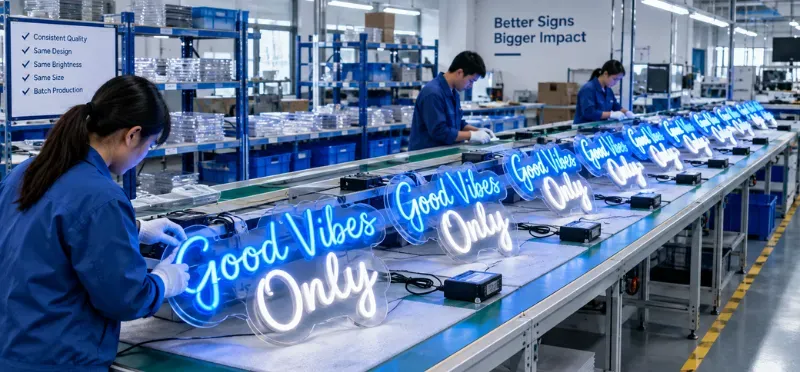
There are a number of warning signs to look out for before placing a bulk order:
- No LED lifespan guarantee, or fuzzy terms like "long-lasting LEDs" without an hour rating.
- A genuine manufacturer will be able to provide CE/RoHS/UL documentation, if requested.
- Any glass tubes labeled as "traditional neon" without any breakage or shipping protection listed.Any glass tubes sold under the name "traditional neon" without any breakage or shipping protection listed.
- Sample unit looks good, but there is no mention of a batch QC process
- Price is substantially below average for the market, and not in any way material or production related
None of these necessarily indicate a bad supplier; rather, they suggest you are looking at pricing, not quality. If you're still whittling down your suppliers, the following article about how to vet a good supplier for large neon orders expands on the trust and verification aspect of supplier vetting.
Frequently Asked Questions
What makes a neon sign wholesale-grade?
A neon sign is wholesale-grade if its production materials include silicone neon flex tubing, UV-stable acrylic backing, quality PCBs, 30000-50000-hour LED chips, CE/RoHS/UL documentation, and consistent production quality across all units in the order.
How can I tell if a neon sign is good quality before buying wholesale?
Ask about LED lifetime in hours, about certifications (CE/RoHS/UL), and about the quality control system applied to all batches and not only to the sample. If the supplier cannot give an exact answer to these questions, the item was probably not even tested to meet wholesale standards.
What materials are used in wholesale-grade neon signs?
The silicone neon flex tubing (not glass), UV-stable acrylic backing panels, commercial-grade PCBs for reliable power delivery, and equal-binned LED chips for consistent color output are signs of a well-made neon sign.
How long do wholesale-grade neon signs typically last?
Most wholesale-grade LED neon signs can provide 30000-50000 hours of continuous lighting, which is approximately 8 to 15 years of typical commercial or retail use. The LED neon sign’s lifetime depends on the LED’s quality and the power supply board's stability, not on the product’s price.
What certifications should wholesale neon signs have?
The compulsory conformity assessment certifications that a neon sign should possess are CE (European conformity), RoHS (restriction of hazardous substances), and UL (electrical safety certification for insurance purposes). An additional requirement for an outdoor-use neon sign is IP65/IP67 certification, which indicates the product’s resistance to water and dust.
Ready to Order Signage That Actually Meets the Standard?
The price range alone will not indicate if a neon sign is made to a wholesale-grade standard. To ensure you choose the right manufacturer for your wholesale needs, visit our website to explore our neon sign wholesale collection. We can provide CE/RoHS/UL-certified, factory-direct signage products manufactured to the highest industry standards mentioned above.
Featured Articles
Wholesale is no longer a promise; it's a price tag. Put it into any B2B marketplace, and you'll receive a deluge of l...
READ FULLAn order for a large neon sign carries a different kind of risk than that of a sign for your shop window. A poor supp...
READ FULLCreating custom window display props requires a careful balance between visual appeal and structural durability. When...
READ FULL